For Help 24/7, Call Now

(856) 596-1600

(856) 596-1600   |  Start a Referral 

music therapy - guitar in the field

South New Jersey Hospice Music Therapy

The traditional hospice team includes healthcare professionals from numerous disciplines, volunteers, and complementary therapists who provide supportive care and comfort through natural approaches. One of these approaches is using music therapy in hospice care.

What is Hospice Music Therapy?

By definition, music therapy is the clinical and evidence-based use of music by a board-certified music therapist (MT-BC) to meet individuals’ physical, emotional, and spiritual needs. In practice, music therapy for end-of-life care has been shown to accomplish a number of goals.
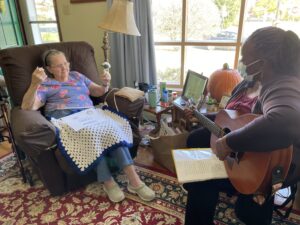
Alice seated on a brown couch with a flower in hand and a knitted blanket on her lap. She sits facing Charity, music therapist, who has a guitar on her lap and a mask on. Charity is playing music.

What are the Benefits of Music Therapy in Hospice Care?

Our hospice music therapy program benefits South NJ patients in the following ways:

  • Pain management
  • Anxiety reduction
  • Expression of emotions (verbally and non-verbally)
  • Processing grief-related feelings and experiences
  • Increasing feelings of meaning/purpose
  • Improving comfort
  • Fostering a sense of resilience
  • Providing a normative experience
  • Increasing opportunities for meaningful socialization
  • Increasing feelings of closeness, acceptance, and intimacy
  • Resolving family conflict/relational stress
  • Increasing self-esteem/self-acceptance
  • Increasing range of coping mechanisms
  • Enhancing quality of life
  • Gaining a sense of spiritual support
  • Fostering meaningful sensory engagement
  • Creating positive memories at the end of life


A donation to Samaritan can help provide hospice music therapy for those who could benefit from it.

Donate Now.

A woman singing in front of a microphone

How is Music Therapy Used for End-of-Life Care?

Our South NJ hospice music therapy services weave together each patient/family’s individual goals and objectives with their unique personal music history and preferences, designing a course of therapy that utilizes primarily live music (including guitar, piano, voice, and/or various percussion instruments) as well as receptive/listening-based interventions during music therapy sessions. Music therapy experiences within end-of-life care may include any of the following:

  • Singing songs: any combination of music therapist, patient, or family singing preferred, familiar songs as a means to reminisce and validate patient’s life history, and as a normalizing experience for patients/families in the present
  • Music-assisted relaxation: providing individualized live or recorded music with guided discussion, imagery, or mantras to help patients decrease pain, anxiety, or discomfort
  • Song lyric discussion: listening to and analyzing live or recorded music as a means of identifying, relating to, and processing patient and family grief-related emotions and experiences
  • Instrumental improvisation: playing rhythmic or melodic instruments with music therapist or family as a non-verbal means to identify, express, and validate emotions. Outside of the hospice care setting, this form of music therapy is often utilized when helping children identify and express emotions
  • Songwriting and composition: working with music therapist to give voice to feelings or experiences related to hospice journey by writing original song(s) containing lyrics, acoustic, and/or virtual instruments
  • Song parody: re-writing portions of a known song to reflect and express a patient’s and families’ own emotions and experiences
  • Music legacy projects: Creating a CD of songs that have been important to patient, have accompanied significant life milestones, or are dedications to loved ones. The CD’s are often given to family and friends, creating a lasting and meaningful connection both before and after death
  • Planning music for funeral or memorial service
  • Procedural support music therapy: providing live music to help refocus patient’s and/or families’ awareness from potentially stressful or painful procedures such as wound care


Please check with your hospice team to find out if you or your loved one is eligible for music therapy. Music therapy is offered in select hospice care locations.

About Our Hospice Music Therapists

Music has always played a major part in Charity’s life. Raised in a close-knit family of singers, musicians and artists, Charity Jones, MMAT, MT-BC, began singing duets with her father at an early age. Charity went on to major in music education with concentration in voice at West Chester University, and received an undergrad degree in social science from Ashford University. She worked in behavioral health for over 10 years as a behavioral support specialist, working primarily with adults with intellectual disabilities, as well as taught pre-school music around the Philadelphia area. Charity returned to school to complete a master of arts degree in music therapy in 2017. She started working at Samaritan in June of 2020.


Charity has a love of sharing music and creating life-affirming connections with hospice patients. She enjoys working in an interdisciplinary-team setting to create a safe and secure environment for patients, as well as, enhance their quality of life using the wondrous gift of music. In her free time, Charity sings with her family as part of a singing group, occasionally gets involved in stage and theater work in her home city of Philadelphia, and is developing a music therapy program with a drama component for pre-schools in the Philadelphia area.

What is the best music for hospice patients?

The best music for patients using hospice music therapy is highly personal and depends on their individual preferences, cultural background, and emotional needs. For some, soothing classical or instrumental music may provide relaxation and reduce anxiety. Others may find comfort in nostalgic songs that evoke positive memories or reflect their personal history. Spiritual or religious music can also bring peace to patients seeking solace during this time.  
 
Music therapists often work with patients and families to identify and use music that resonates deeply, enhancing comfort and emotional well-being. 

Music Therapy Playlist

Enjoy this music play list (10 videos) created especially for you by Samaritan Board-certified Music Therapist Sara Kuhlen, MA. Learn about the benefits of music therapy and the power of singing. Sing along to some of her most-requested songs. Also enjoy songs for relaxation and meditation.
Smile, mother and child in a garden for love, peace and care together on mothers day. Happy, relax and calm woman with affection for her senior mom at a home for people in retirement in a backyard

Ready to learn more about Music Therapy in southern New Jersey? 

Contact us today

 (856) 596-1600 

What can we help you find?